
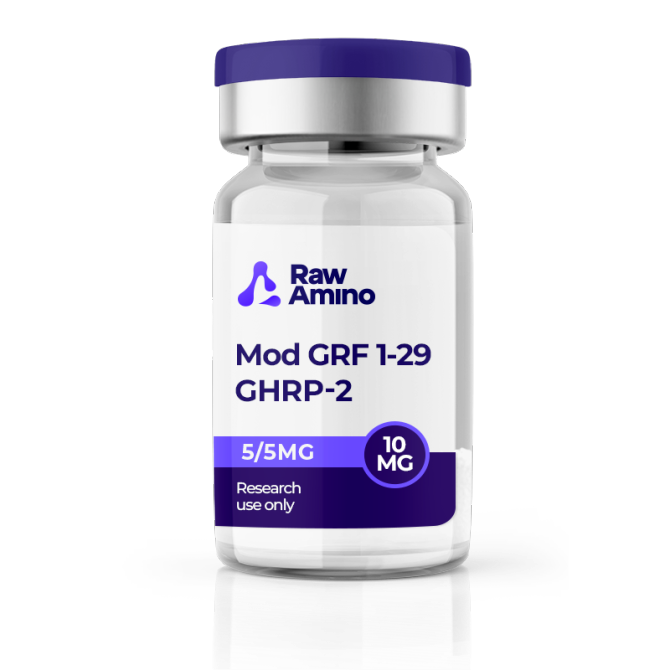
Mod GRF 1-29 & GHRP-2 – 10MG: Powerful Peptide Stack for Growth Hormone Support
What Is Mod GRF 1-29 & GHRP-2 – 10MG?
Mod GRF 1-29 and GHRP-2 form a powerful peptide combination.
Researchers widely study this stack for growth hormone stimulation.
Both peptides work through different mechanisms inside the body.
Therefore, their combination creates a strong synergistic effect.
Mod GRF 1-29 acts as a growth hormone releasing hormone analog.
It signals the pituitary gland to release natural growth hormone.
Meanwhile, GHRP-2 stimulates growth hormone release through ghrelin receptors.
Consequently, the body produces higher pulses of growth hormone naturally.
This peptide blend usually comes in a 10MG lyophilized powder format.
Researchers then reconstitute the powder before laboratory use.
Moreover, the blend often appears in peptide research and performance studies.
How Mod GRF 1-29 Works
Mod GRF 1-29 improves the body’s natural growth hormone signaling pathway.
It mimics the natural growth hormone releasing hormone.
Therefore, the pituitary gland receives a strong release signal.
However, Mod GRF 1-29 has a shorter half-life than some similar peptides.
This shorter half-life allows more controlled hormone pulses.
Additionally, it reduces prolonged stimulation of the pituitary gland.
Because of this design, researchers often prefer Mod GRF 1-29.
Furthermore, the peptide works best when combined with GHRP compounds.
Thus, the pairing with GHRP-2 creates a reliable hormone release pattern.
Role of GHRP-2 in the Peptide Stack
GHRP-2 belongs to the growth hormone releasing peptide family.
It activates ghrelin receptors within the pituitary gland.
As a result, the body releases significant growth hormone pulses.
Unlike Mod GRF 1-29, GHRP-2 works through a different biological pathway.
Therefore, the two peptides complement each other perfectly.
Moreover, GHRP-2 increases the amplitude of hormone release.
Additionally, this peptide may influence appetite and metabolism.
For example, some research notes increased hunger during peptide exposure.
However, growth hormone stimulation remains the primary research focus.
Benefits of Combining Mod GRF 1-29 with GHRP-2
Combining these peptides creates a strong synergistic response.
Each compound enhances the effect of the other.
Therefore, researchers observe larger growth hormone pulses.
This peptide stack supports several areas of study.
For example, scientists investigate muscle development and recovery.
Additionally, research explores fat metabolism and body composition changes.
Furthermore, growth hormone plays a role in cellular repair.
Thus, peptide stimulation may support recovery research.
Meanwhile, many studies examine anti-aging hormone pathways.
Researchers also evaluate metabolic effects during peptide cycles.
Consequently, the combination remains popular in peptide research environments.
Potential Research Applications
Scientists frequently analyze this peptide stack in controlled studies.
Growth hormone stimulation remains the central research objective.
However, several related fields also benefit from peptide investigation.
For instance, muscle regeneration research often uses GH secretagogues.
Additionally, recovery studies explore hormone-driven tissue repair mechanisms.
Therefore, Mod GRF 1-29 and GHRP-2 appear in many experimental protocols.
Moreover, metabolic studies evaluate how growth hormone affects fat utilization.
Some research also examines insulin sensitivity changes.
Meanwhile, other projects investigate hormone rhythms and endocrine responses.
Because of these uses, peptide stacks remain highly valuable in laboratory work.
Why Researchers Prefer the 10MG Peptide Blend
The 10MG vial offers practical dosing flexibility.
Researchers can divide the contents for multiple experimental sessions.
Additionally, lyophilized peptides maintain stability during storage.
Freeze-dried peptides preserve their structure until reconstitution occurs.
Therefore, laboratories maintain consistent peptide quality.
Furthermore, proper storage conditions extend product shelf life.
The compact format also simplifies laboratory inventory management.
Consequently, peptide research facilities often stock multiple vials.
Storage and Handling Considerations
Peptides require careful handling to maintain stability.
Researchers typically store lyophilized peptides in cool environments.
Additionally, protection from light preserves peptide integrity.
After reconstitution, refrigeration becomes necessary.
Therefore, laboratories maintain controlled storage temperatures.
Moreover, sterile laboratory practices help avoid contamination.
Proper handling ensures reliable experimental outcomes.
Consequently, strict protocols remain essential in peptide research settings.
Growing Interest in Growth Hormone Peptides
Growth hormone peptides attract increasing scientific interest.
Researchers continue exploring endocrine pathways and hormone signaling.
Therefore, peptides like Mod GRF 1-29 remain important research tools.
Meanwhile, GHRP compounds expand the possibilities of hormone modulation.
Together, they create precise growth hormone stimulation patterns.
Furthermore, peptide stacks allow controlled endocrine research.
As a result, laboratories continue investigating their biological effects.
Consequently, Mod GRF 1-29 and GHRP-2 remain widely discussed in peptide science.
Conclusion
Mod GRF 1-29 and GHRP-2 create a highly effective peptide combination.
Each compound stimulates growth hormone release through unique pathways.
Therefore, the synergy produces stronger hormone pulses.
Researchers value this stack for endocrine and metabolic studies.
Additionally, its reliable mechanism supports many laboratory experiments.
Moreover, the 10MG format offers flexibility and convenience.
Consequently, Mod GRF 1-29 and GHRP-2 remain a leading peptide research stack.
Their combined action continues to attract strong scientific attention.
Finally, peptide research will likely expand as hormone science evolves.
Reviews
There are no reviews yet.