
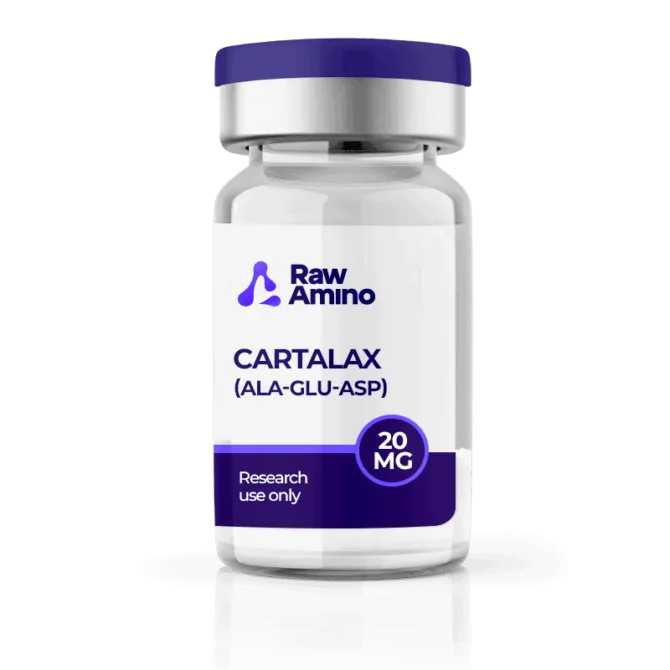
Cartalax – 20MG
Cartalax 20MG: Advanced Peptide for Cartilage Regeneration and Joint Support
What Is Cartalax 20MG?
Cartalax 20MG is a synthetic peptide studied for cartilage repair and connective tissue support. Researchers classify it as a short-chain bioregulatory peptide derived from cartilage proteins.
The compound contains a tripeptide sequence known as Ala-Glu-Asp (AED). This structure interacts with cellular mechanisms involved in tissue repair and regeneration. Consequently, scientists investigate it for joint health and cartilage restoration research. (BioEdge Research Labs)
Cartalax is commonly supplied as a 20 mg lyophilized powder in a vial. Laboratories typically reconstitute the compound before experimental use. (Amino USA)
How Cartalax 20MG Works in Connective Tissue
Cartalax acts directly on connective tissue cells, especially chondrocytes. These cells maintain cartilage structure and elasticity.
The peptide penetrates cells and interacts with genetic signaling pathways. As a result, it influences the production of structural proteins and repair processes.
Several biological actions have been observed in experimental models:
- Stimulates collagen synthesis
- Supports extracellular matrix stability
- Reduces inflammatory signaling
- Encourages cellular regeneration
Therefore, Cartalax creates an environment that promotes tissue maintenance and repair.
Key Benefits Studied in Research Models
Researchers focus on Cartalax because of its potential regenerative properties. Studies indicate multiple possible advantages for connective tissues.
1. Cartilage Regeneration
Cartalax helps regulate protein synthesis in cartilage cells. Consequently, it may support cartilage repair and structural integrity.
2. Joint Mobility Support
Healthy cartilage improves joint flexibility and movement. Cartalax research suggests it may help maintain joint resilience during stress.
3. Anti-Inflammatory Effects
Inflammation damages connective tissues over time. Cartalax appears to regulate inflammatory signals and protect tissue balance.
4. Cellular Aging Reduction
Some studies explore Cartalax for its influence on cellular aging markers. Researchers believe it may help maintain healthier cell function in connective tissues.
Scientific Composition and Structure
Cartalax has a simple yet biologically active molecular structure. Its composition enables efficient interaction with cellular processes.
Key specifications include:
- Peptide sequence: Ala-Glu-Asp (AED)
- Molecular formula: C12H19N3O8
- Molecular weight: 333.29 g/mol
- Peptide type: Synthetic bioregulator
This minimal structure allows the peptide to influence gene expression linked to tissue repair.
Applications in Joint and Cartilage Research
Scientists frequently use Cartalax in studies involving connective tissue health. Several research areas focus on its regenerative potential.
Common research applications include:
- Osteoarthritis models
- Cartilage degeneration studies
- Sports injury recovery models
- Connective tissue aging research
Because of its regulatory activity, Cartalax often appears in experimental protocols examining joint restoration and cellular repair.
Cartalax 20MG Dosage in Experimental Protocols
Research protocols vary depending on the study design. However, many experimental models explore 10–20 mg daily cycles.
Some laboratory protocols examine treatment periods lasting 10 to 30 days. Researchers then evaluate tissue response and cellular regeneration markers. It is important to note that Cartalax remains primarily a research compound.
Safety and Regulatory Status
Cartalax is currently classified as a research peptide. Most suppliers label it strictly for laboratory investigation.
Regulatory agencies have not approved it for routine medical use. Therefore, laboratories must follow strict research handling procedures.
Researchers also store the peptide at controlled temperatures to maintain stability and purity.
Future Potential of Cartalax Peptide Research
Cartalax continues to attract interest in regenerative medicine studies. Scientists investigate its potential role in cartilage repair and connective tissue longevity.
Future research may expand knowledge about peptide-based therapies for joint degeneration. Moreover, deeper studies could clarify its molecular effects and therapeutic potential.
Conclusion
Cartalax 20MG represents a promising peptide in cartilage and connective tissue research. Its simple structure allows interaction with cellular repair pathways.
Researchers study it for cartilage regeneration, inflammation control, and joint support. As peptide science advances, Cartalax may contribute valuable insights into tissue regeneration and musculoskeletal health.
Reviews
There are no reviews yet.