
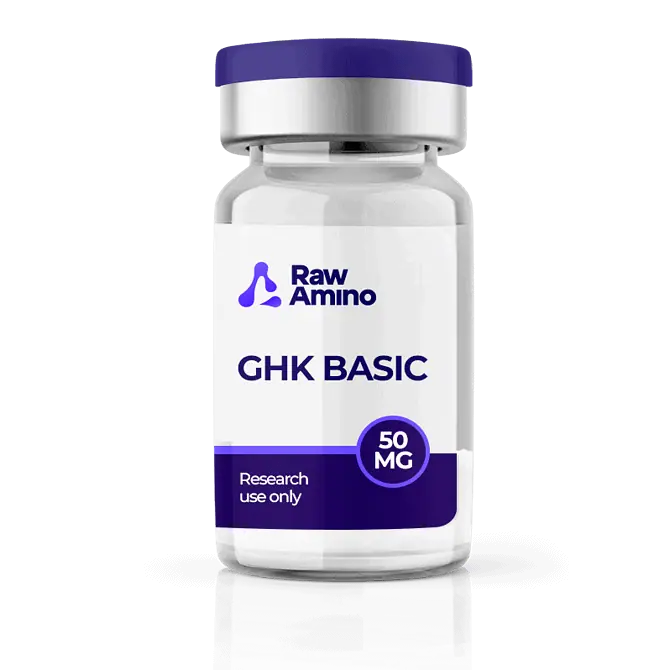
GHK Basic – 50MG
GHK Basic – 50MG: Advanced Peptide Support for Skin Renewal and Cellular Health
What Is GHK Basic – 50MG?
GHK Basic is a peptide compound widely studied in regenerative biology.
Researchers know it as glycyl-L-histidyl-L-lysine, a naturally occurring tripeptide.
Originally, scientists identified this peptide in human plasma.
However, they later discovered it in saliva and urine as well.
GHK plays a role in cellular signaling.
Therefore, it influences tissue repair and regeneration processes.
A 50MG preparation offers a concentrated quantity for laboratory and research applications.
Consequently, researchers can explore its biological properties with higher precision.
Molecular Structure and Biological Role
GHK consists of three amino acids linked in sequence.
These amino acids include glycine, histidine, and lysine.
Together, they form a stable peptide structure.
Moreover, this structure allows effective interaction with copper ions.
The peptide often binds copper to form GHK-Cu.
However, the base peptide itself remains valuable for research studies.
GHK regulates several genes involved in healing.
Additionally, it activates pathways connected to tissue remodeling.
Meanwhile, it helps restore balanced cellular function.
Therefore, many laboratories study its regenerative potential.
Key Benefits Observed in Research
1. Skin Regeneration Support
GHK peptides strongly influence skin renewal pathways.
For example, they stimulate fibroblast activity in laboratory models.
Fibroblasts produce collagen and structural proteins.
Consequently, skin structure improves in experimental conditions.
Furthermore, GHK promotes elastin synthesis.
Therefore, researchers associate it with improved skin elasticity.
2. Collagen Production Enhancement
Collagen maintains structural strength in tissues.
However, collagen production declines with age.
GHK appears to stimulate collagen-related gene expression.
As a result, scientists study its role in dermal repair.
Additionally, the peptide supports extracellular matrix rebuilding.
Consequently, tissue architecture may stabilize over time.
3. Anti-Inflammatory Activity
Inflammation affects many biological processes.
However, controlled regulation can support healing.
GHK helps modulate inflammatory signaling molecules.
Therefore, researchers examine its protective cellular effects.
Moreover, it influences oxidative stress pathways.
Consequently, cells may maintain healthier environments during recovery.
4. Wound Healing Mechanisms
Tissue repair requires coordinated biological responses.
GHK participates in several stages of healing.
First, it stimulates migration of repair cells.
Next, it supports structural protein production.
Meanwhile, it enhances blood vessel formation signals.
Therefore, oxygen delivery improves in experimental models.
Why Researchers Use a 50MG Concentration
A 50MG vial provides a practical amount for experimental protocols.
Consequently, laboratories can perform multiple analytical tests.
Higher quantities support consistent dosage calculations.
Additionally, they improve experimental repeatability.
Researchers also prefer standardized concentrations.
Therefore, results remain comparable across different studies.
Potential Applications in Scientific Research
GHK continues to attract attention in biomedical research.
Several areas currently receive significant focus.
Dermatological Studies
Scientists explore peptide effects on skin regeneration.
Additionally, they analyze interactions with dermal cell cultures.
Aging Research
Age-related cellular decline interests many laboratories.
Therefore, GHK serves as a model compound for regeneration studies.
Tissue Engineering
Regenerative medicine requires signals for cellular growth.
Consequently, peptides like GHK receive strong scientific interest.
Hair Follicle Research
Hair follicle cells respond to peptide signaling.
Moreover, GHK may influence follicular microenvironments in experiments.
Mechanisms Behind GHK Activity
Several biological pathways explain GHK’s potential effects.
However, researchers continue to analyze these mechanisms.
The peptide influences gene expression linked to repair.
Therefore, cells activate regenerative programs.
Additionally, GHK regulates metalloproteinase enzymes.
Consequently, damaged extracellular matrix components break down efficiently.
Meanwhile, new structural proteins replace older tissues.
Thus, the remodeling process becomes more organized.
Handling and Storage Considerations
Proper handling preserves peptide stability.
Therefore, laboratories store GHK peptides in controlled environments.
Cold storage conditions maintain structural integrity.
Additionally, low light exposure protects peptide quality.
Researchers often reconstitute peptides with sterile solvents.
Consequently, solutions remain suitable for experimental use.
Quality Factors in Research Peptides
Purity strongly affects experimental reliability.
Therefore, high-grade peptide synthesis remains essential.
Manufacturers typically verify purity through analytical testing.
For example, high-performance liquid chromatography confirms peptide identity.
Additionally, mass spectrometry ensures correct molecular weight.
Consequently, researchers receive consistent compounds for study.
Future Research Potential
Peptide science continues evolving rapidly.
Therefore, GHK remains an important molecule in regenerative research.
Scientists investigate broader biological interactions.
Moreover, they examine gene regulatory effects more closely.
Meanwhile, advances in biotechnology improve peptide applications.
Consequently, future studies may reveal additional therapeutic insights.
Conclusion
GHK Basic – 50MG represents a valuable peptide for laboratory research.
Its biological signaling properties attract attention across scientific disciplines.
Furthermore, the peptide influences regeneration-related pathways.
Therefore, it remains central to ongoing experimental exploration.
Researchers continue analyzing its molecular mechanisms.
Overall, GHK offers promising potential within modern peptide science.
Reviews
There are no reviews yet.